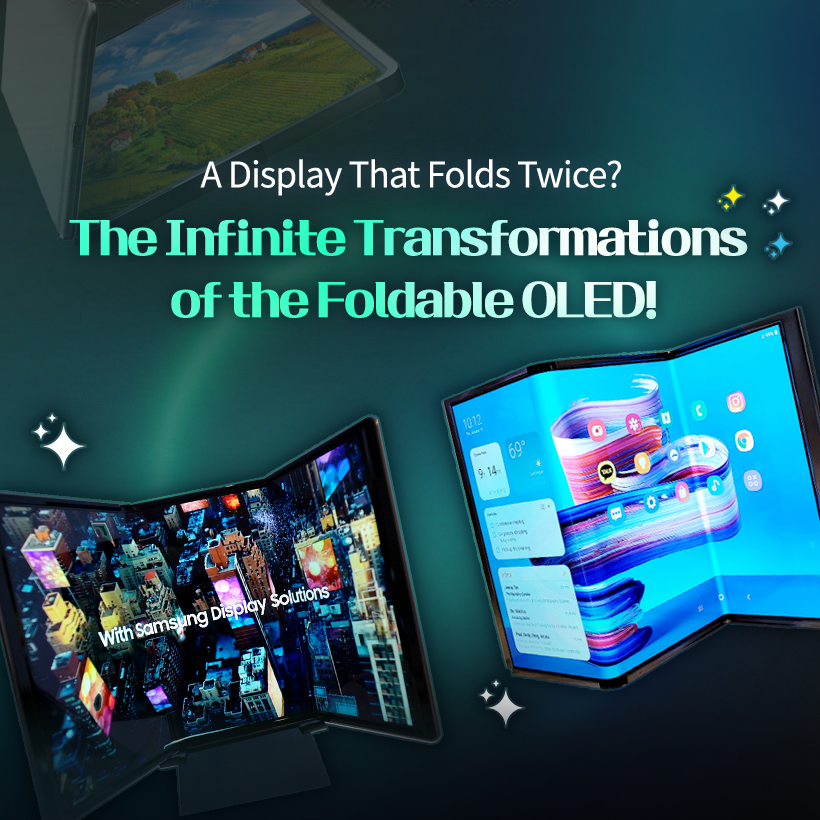
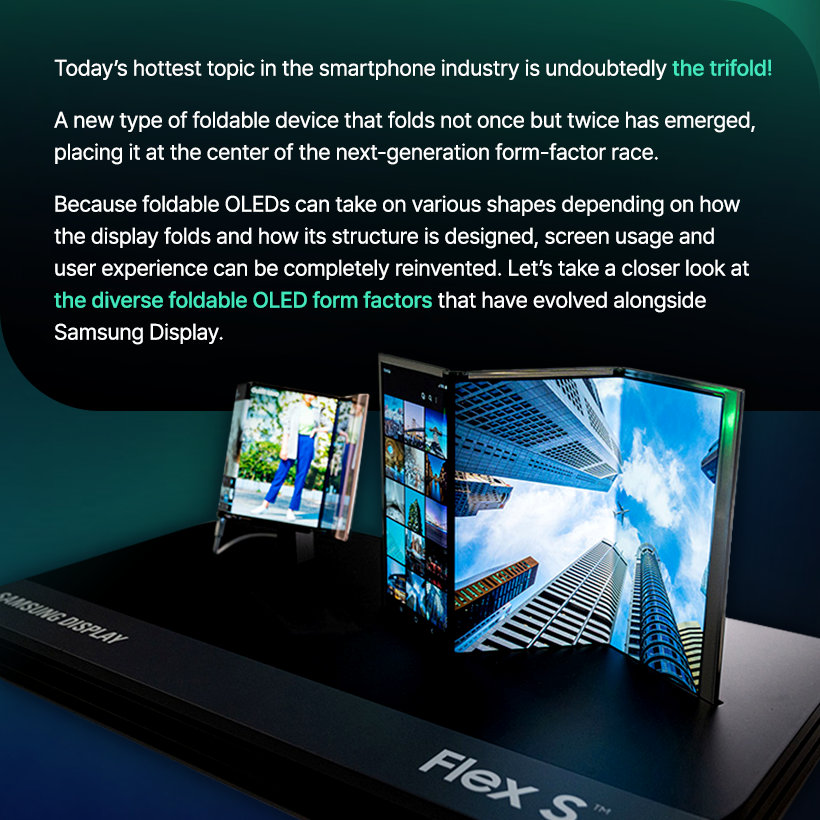
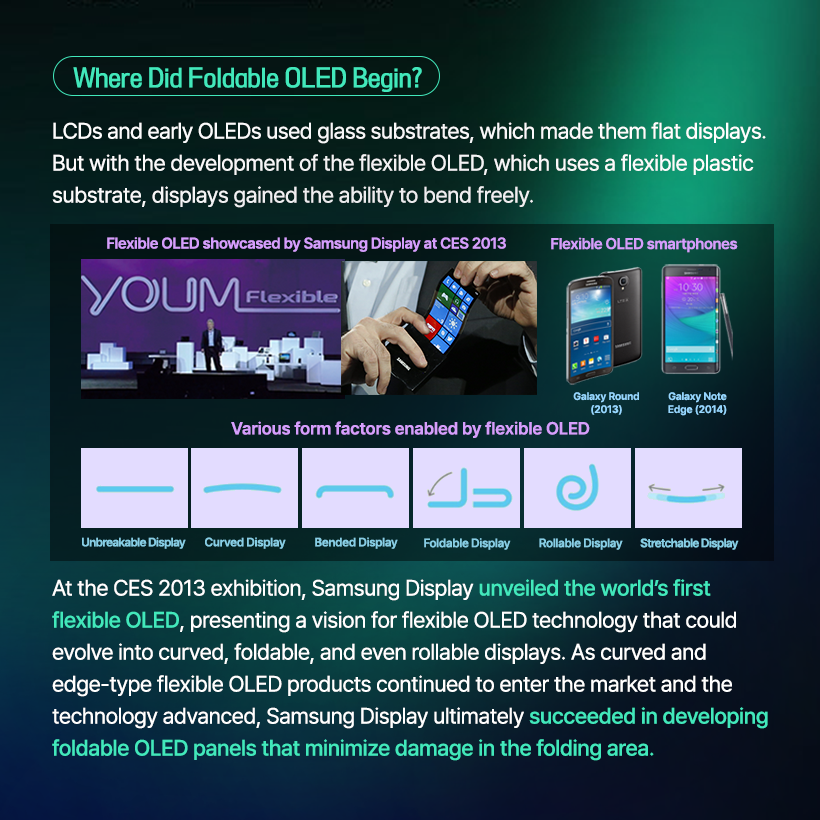
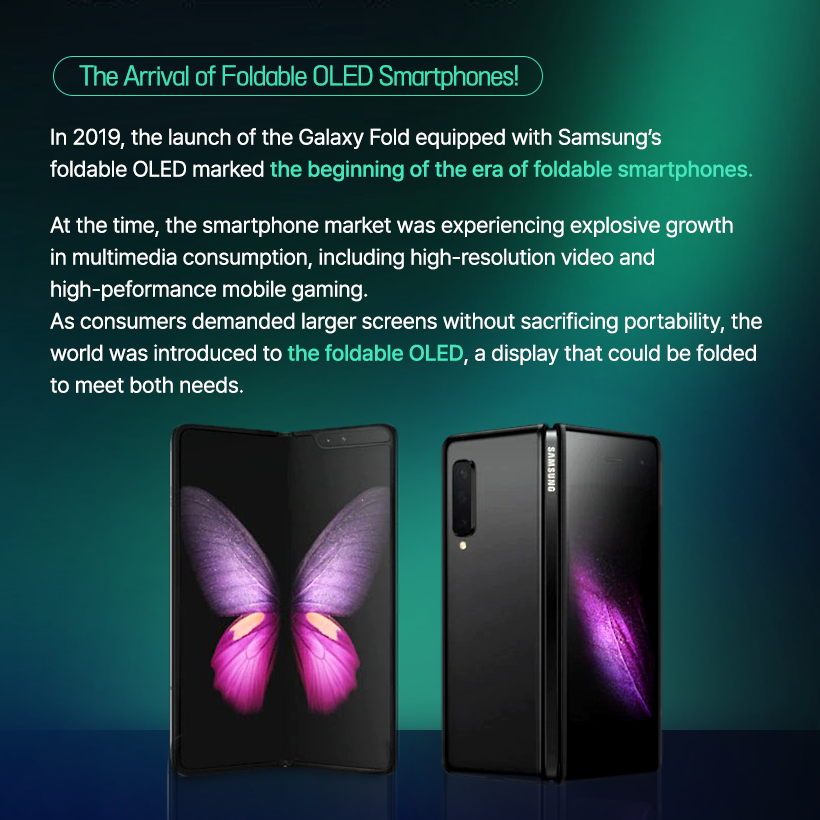
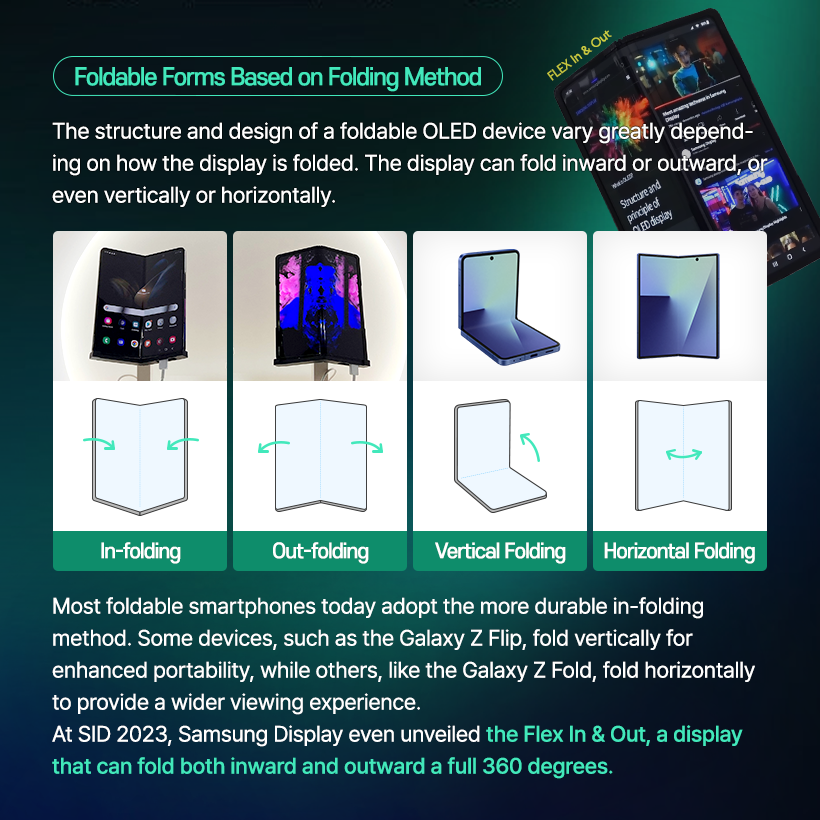
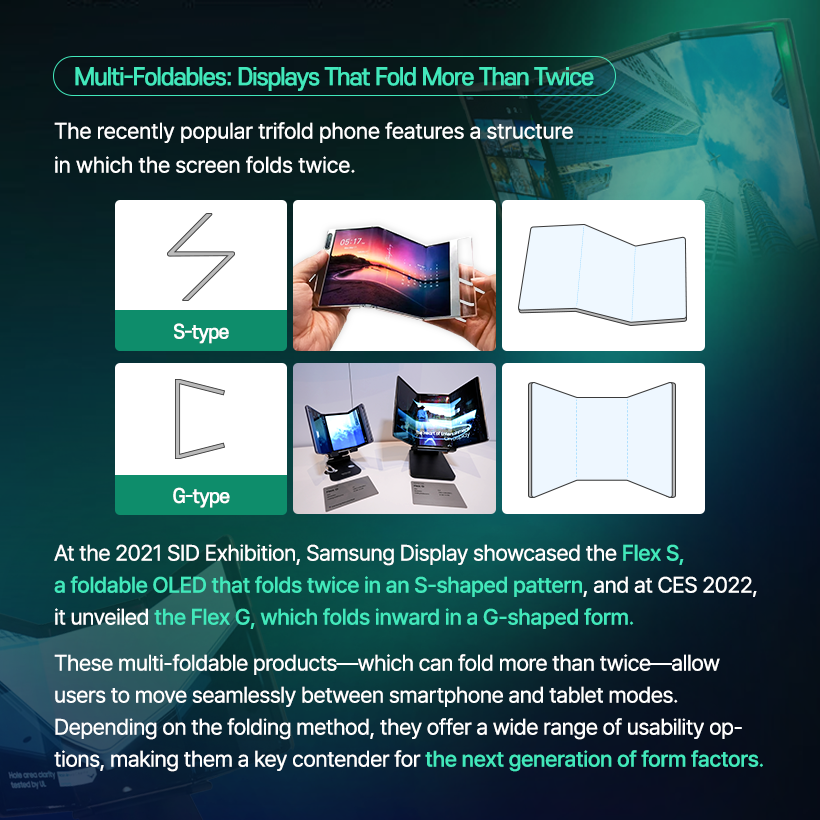
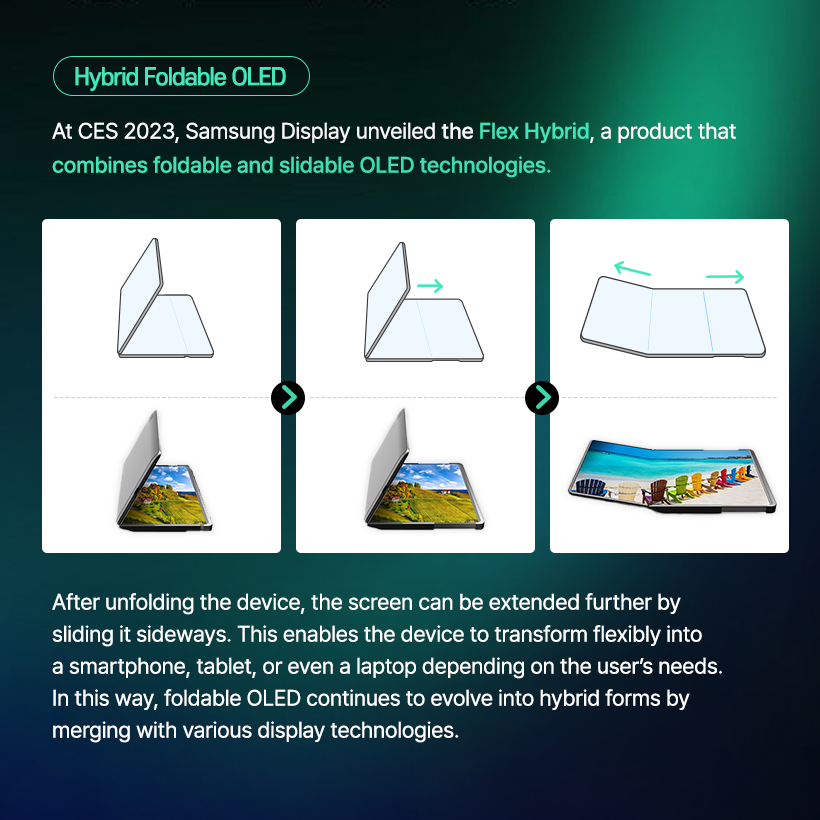
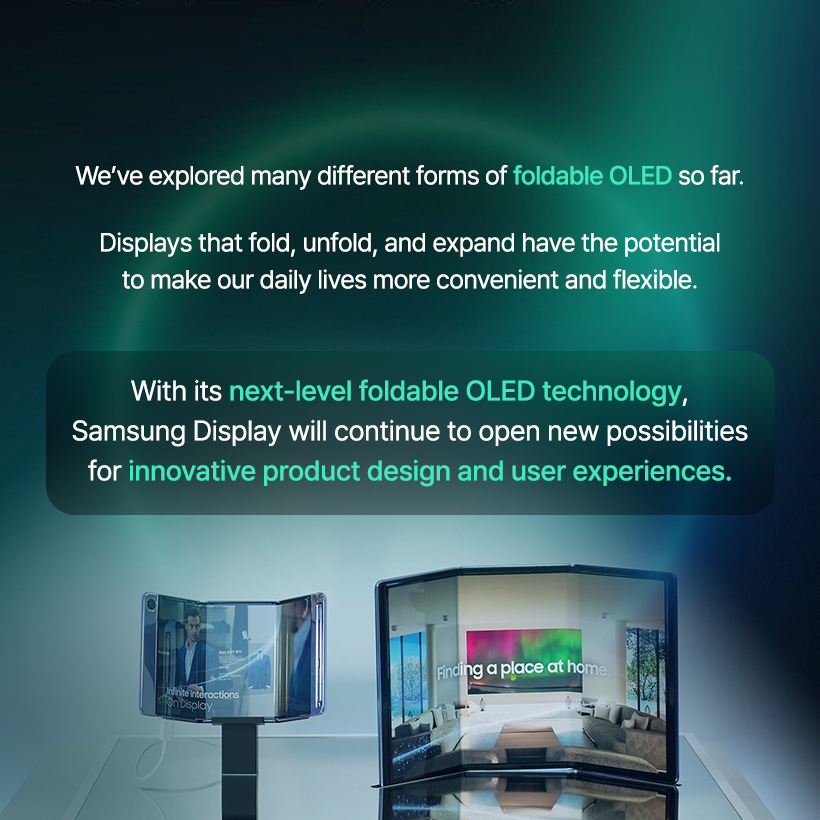
A Display That Folds Twice?  The Infinite Transformations of the Foldable OLED!  Today’s hottest topic in the smartphone industry is undoubtedly the trifold! A new type of foldable device that folds not once but twice has emerged, placing it at the center of the next-generation form-factor race.  Because foldable OLEDs can take on various shapes depending on how the display folds and how its structure is designed, screen usage and user experience can be completely reinvented. Let’s take a closer look at the diverse foldable OLED form factors that have evolved alongside Samsung Display. Where Did Foldable OLED Begin? LCDs and early OLEDs used glass substrates, which made them flat displays.  But with the development of the flexible OLED, which uses a flexible plastic substrate, displays gained the ability to bend freely.  Flexible OLED showcased by Samsung Display at CES 2013 Flexible OLED smartphones: Galaxy Round (2013), Galaxy Note Edge (2014) Various form factors enabled by flexible OLED At the CES 2013 exhibition, Samsung Display unveiled the world’s first flexible OLED, presenting a vision for flexible OLED technology that could evolve into curved, foldable, and even rollable displays. As curved and edge-type flexible OLED products continued to enter the market and the technology advanced, Samsung Display ultimately succeeded in developing foldable OLED panels that minimize damage in the folding area.  The Arrival of Foldable OLED Smartphones! In 2019, the launch of the Galaxy Fold equipped with Samsung’s foldable OLED marked the beginning of the era of foldable smartphones.  At the time, the smartphone market was experiencing explosive growth in multimedia consumption, including high-resolution video and high-performance mobile gaming.  As consumers demanded larger screens without sacrificing portability, the world was introduced to the foldable OLED, a display that could be folded to meet both needs.  Foldable Forms Based on Folding Method The structure and design of a foldable OLED device vary greatly depending on how the display is folded. The display can fold inward or outward, or even vertically or horizontally.  In-folding, Out-folding, Vertical Folding, Horizontal Folding Most foldable smartphones today adopt the more durable in-folding method.  Some devices, such as the Galaxy Z Flip, fold vertically for enhanced portability, while others, like the Galaxy Z Fold, fold horizontally to provide a wider viewing experience.  At SID 2023, Samsung Display even unveiled the Flex In & Out, a display that can fold both inward and outward a full 360 degrees. Multi-Foldables: Displays That Fold More Than Twice The recently popular trifold phone features a structure in which the screen folds twice. S-type, G-type At the 2021 SID Exhibition, Samsung Display showcased the Flex S, a foldable OLED that folds twice in an S-shaped pattern, and at CES 2022, it unveiled the Flex G, which folds inward in a G-shaped form.  These multi-foldable products—which can fold more than twice—allow users to move seamlessly between smartphone and tablet modes. Depending on the folding method, they offer a wide range of usability options, making them a key contender for the next generation of form factors. Hybrid Foldable OLED At CES 2023, Samsung Display unveiled the Flex Hybrid, a product that combines foldable and slidable OLED technologies.  After unfolding the device, the screen can be extended further by sliding it sideways.  This enables the device to transform flexibly into a smartphone, tablet, or even a laptop depending on the user’s needs. In this way, foldable OLED continues to evolve into hybrid forms by merging with various display technologies.  We’ve explored many different forms of foldable OLED so far.  Displays that fold, unfold, and expand have the potential to make our daily lives more convenient and flexible.  With its next-level foldable OLED technology, Samsung Display will continue to open new possibilities for innovative product design and user experiences.