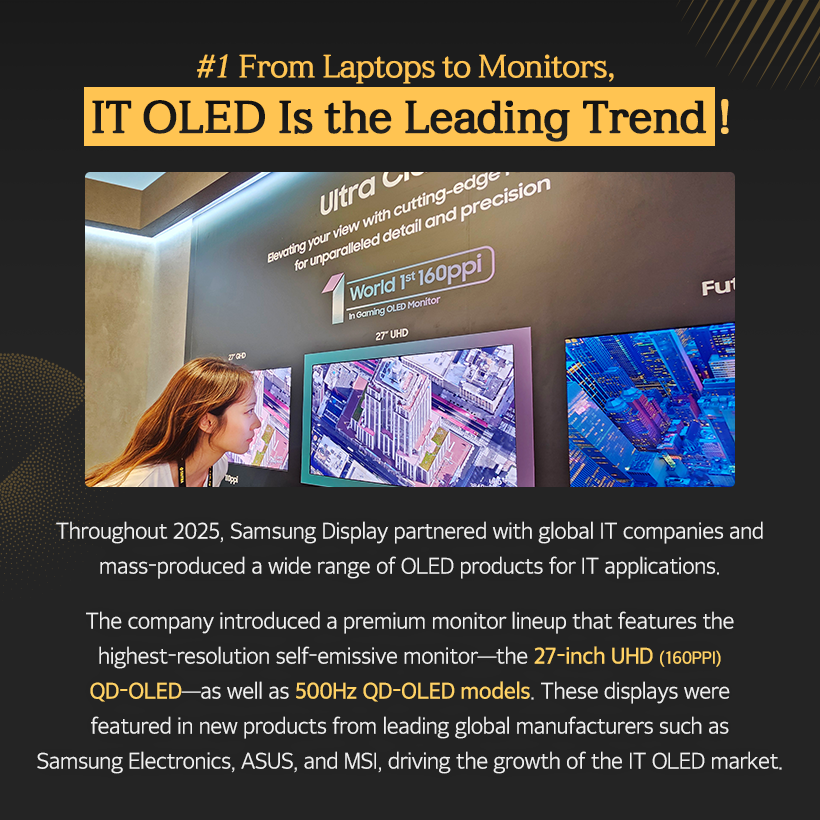
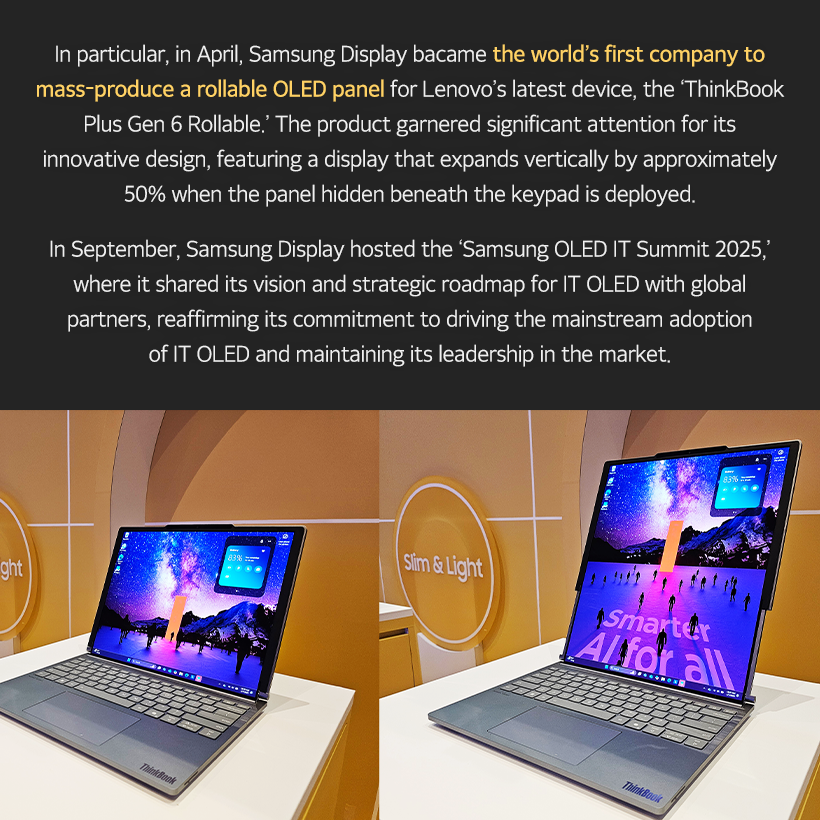
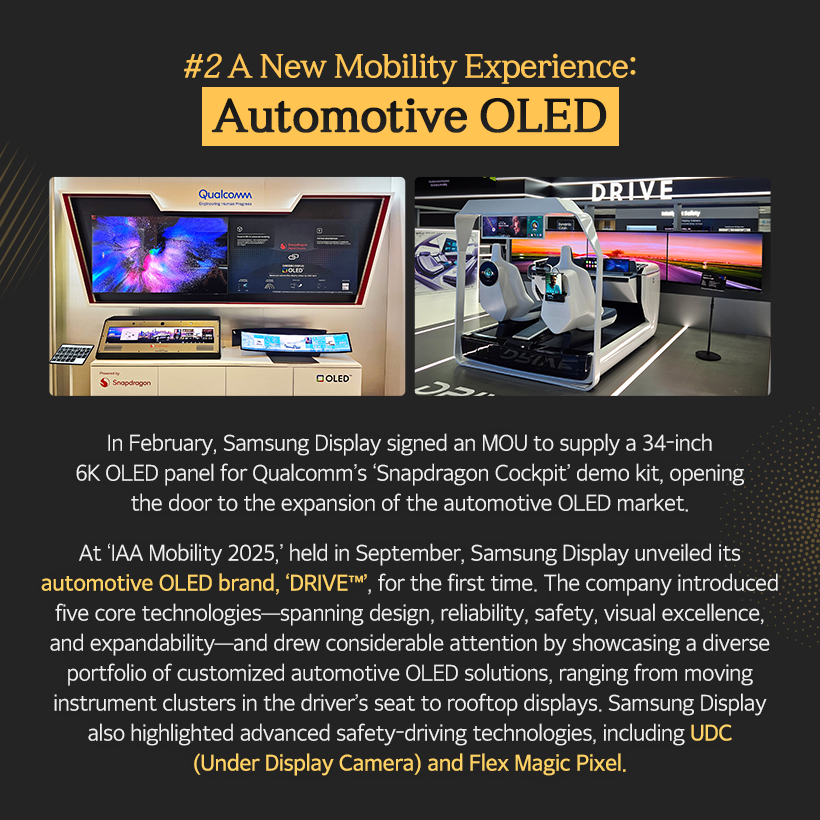
1p. SDC Highlights in 2025 What kind of year was 2025 for you?  For Samsung Display, 2025 was a milestone year, showcasing our leadership in display technology across diverse fields—including IT, mobility, and XR—driven by new challenges and technological advancements.  Let’s now take a closer look at the key technologies Samsung Display introduced in 2025.  2p. #1 From Laptops to Monitors, IT OLED Is the Leading Trend! Throughout 2025, Samsung Display partnered with global IT companies and mass-produced a wide range of OLED products for IT applications.  The company introduced a premium monitor lineup, including the world’s highest-resolution self-emissive monitor—the 27-inch UHD (160 PPI) QD-OLED—as well as 500Hz QD-OLED models. These displays were featured in new products from leading global manufacturers such as Samsung Electronics, ASUS, and MSI, driving the growth of the IT OLED market.  3p.  In particular, in April, Samsung Display became the world’s first company to mass-produce a rollable OLED panel for Lenovo’s latest device, the ‘ThinkBook Plus Gen 6 Rollable.’ The product garnered significant attention for its innovative design, featuring a display that expands vertically by approximately 50% when the panel hidden beneath the keypad is deployed.  In September, Samsung Display hosted the ‘Samsung OLED IT Summit 2025,’ where it shared its vision and strategic roadmap for IT OLED with global partners, reaffirming its commitment to driving the mainstream adoption of IT OLED and maintaining its leadership in the market.  4p. #2 A New Mobility Experience: Automotive OLED In February, Samsung Display signed an MOU to supply a 34-inch 6K OLED panel for Qualcomm’s “Snapdragon Cockpit” demo kit, opening the door to the expansion of the automotive OLED market. At ‘IAA Mobility 2025,’ held in September, Samsung Display unveiled its automotive OLED brand, ‘DRIVE™,’ for the first time. The company introduced five core technologies—spanning design, reliability, safety, visual excellence, and expandability—and drew considerable attention by showcasing a diverse portfolio of customized automotive OLED solutions, ranging from moving instrument clusters in the driver’s seat to rooftop displays. Samsung Display also highlighted advanced safety-driving technologies, including UDC (Under Display Camera) and Flex Magic Pixel.  5p. #4 In the AI Era, Low-Power Display Technology Is Essential! As on-device AI becomes increasingly prevalent, low-power solutions have emerged as a critical enabling technology. In response, Samsung Display introduced a range of advanced low-power display technologies this year.  Among them, ‘LEAD™’ earned the ‘SID Display Industry Award (DIA)’ for Display of the Year. By eliminating the polarizer traditionally used in OLED panels, this polarizer-free OLED technology reduces power consumption while enhancing brightness and outdoor visibility. Samsung Display was the first in the world to commercialize this technology in 2021.  In addition, at ‘Computex 2025’ held in May, Samsung Display unveiled ‘UT One,’ a next-generation low-power technology that enables a 1Hz variable refresh rate in IT OLEDs for the first time. By dynamically adjusting the refresh rate from 1Hz to 120Hz based on displayed content, UT One significantly reduces power consumption.  6p. #3 Even More Powerful Foldable OLED Technology This year, Samsung Display unveiled its proprietary foldable technology brand, ‘MONT FLEX™,’ underscoring its advanced and comprehensive capabilities in foldable OLEDs.  Since initiating mass production in 2019, Samsung Display has continuously enhanced the maturity of its foldable technology, becoming the first in the industry to sequentially adopt ultra-thin glass (UTG) and ‘LEAD™,’ its polarizer-free OCF technology.  In July, a foldable OLED featuring an impact-resistance–enhanced structure successfully passed 500,000 folding tests, earning recognition for its superior design from the global certification body ‘Bureau Veritas.’ More recently, Samsung Display drew significant attention by mass-producing tri-fold OLED panels that fold twice, demonstrating a new level of technological leadership in the foldable display market.  7p. #5 The Secret Behind Crisp XR Screens: Ultra-Fine Display OLEDoS In June, Samsung Display participated for the first time in the global XR exhibition ‘AWE USA 2025,’ where it showcased a broad lineup of OLEDoS technologies—one of the core display technologies for XR devices. OLEDoS is a technology in which OLEDs are fabricated directly on silicon wafers used in semiconductor manufacturing. Despite its compact form factor, it delivers ultra-high resolution through extremely dense pixel integration. At the exhibition, Samsung Display demonstrated its leadership in OLEDoS by unveiling a diverse portfolio of products, including the industry’s highest-resolution 1.4-inch RGB OLEDoS with 5,000 PPI, a 1.3-inch OLEDoS achieving 20,000 nits of brightness, and a 4,000 PPI White OLEDoS.  8p. In 2025, Samsung Display reaffirmed its No.1 technological leadership in the display industry by showcasing a portfolio of differentiated innovations across IT, foldable, automotive, and OLEDoS segments.  Looking ahead to 2026, Samsung Display plans to introduce even more advanced display technologies through continued challenges and innovations—driving progress across new technologies, new products, and new markets.  The future of displays is being shaped by Samsung Display. Stay tuned for what’s coming next.