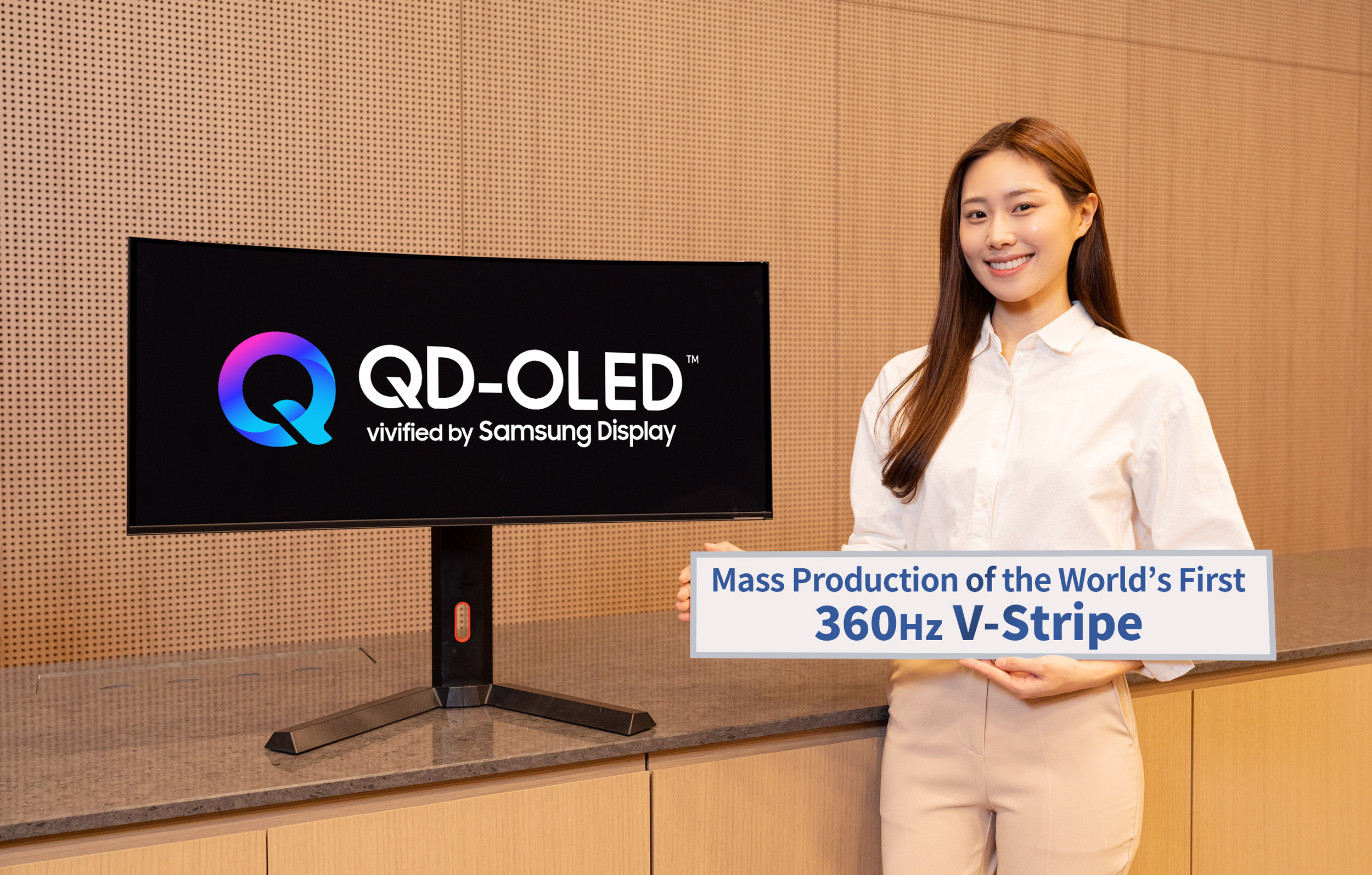
• Samsung Display supplies V-Stripe QD-OLED panels to seven global monitor manufacturers, including ASUS and MSI, for new 2026 monitor models
• The 2026 QD-OLED panels showcase high-performance features, including 21:9 ultra-wide aspect ratio, 360Hz refresh rate, and a peak brightness of 1,300 nits
• The V-Stripe pixel structure enhances text readability, while the panels also offer a wider screen, smoother motion, and faster response times for an optimal gaming experience
• Samsung Display’s QD-OLED is expected to hold a leading 75% share of the monitor OLED panel market in 2025
• Samsung Display continues to drive technological innovation with QD-OLED in the high-end monitor market, the industry’s most competitive battleground
SEOUL, January 1, 2026 - Samsung Display today announced that it has begun the mass production of the world’s first 34-inch 360Hz QD-OLED panel, featuring a “V (Vertical)-Stripe” pixel structure. The company has been supplying the panels to seven global monitor manufacturers including ASUS, MSI, and Gigabyte since December 2025.
The new V-Stripe structure aligns Red, Green, and Blue (RGB) sub-pixels vertically, shifting from the conventional triangular sub-pixel arrangement used in current QD-OLED technology. Developed independently by Samsung Display for quantum dot elements, the V-Stripe structure improves the clarity of text edges, making it ideal for users engaged in text-intensive tasks such as document editing, coding, or content creation.
In addition, the new panel features a 21:9 ultra-wide aspect ratio, a 360Hz refresh rate for ultra-smooth motion and rapid response, and peak brightness of 1,300 nits. These advanced features are expected to drive strong interest among gamers who seek fast-paced, highly immersive gaming experiences such as sports and racing titles.
Compared to a 16:9 display, a 21:9 aspect ratio generally increases the number of horizontal pixels and the volume of data processed, resulting in higher power consumption, greater heat generation, and increased operational demands, even at the same refresh rate. Maintaining uniform signal timing across left and right pixels is also technically challenging, making high refresh rates difficult to achieve.
“The biggest technical challenges in mass-producing high refresh rate panels with a new pixel structure include reduced organic material lifespan, heat generation, and brightness degradation,” said a Samsung Display official. “By leveraging QD-OLED’s top emission structure, which offers brightness advantages, along with improvements in organic material efficiency and design optimization, we were able to mass-produce a high-performance monitor display that integrates four key features: the ‘V-Stripe’ pixel structure, an ultra-wide aspect ratio, a high refresh rate, and enhanced brightness.”
The V-Stripe QD-OLED monitor will be unveiled at CES 2026, starting January 6 in Las Vegas. ASUS and MSI will introduce new monitor models featuring the panels, while Samsung Display will showcase the technology in its private booth at the Encore at Wynn hotel during the event.
According to market research firm Omdia, the share of products equipped with self-emissive panels in the premium monitor segment priced above $500 is expected to rise from 14% in 2024 to 23% in 2025 and further to 27% in 2026, accelerating the industry’s shift from LCD to OLED. Amid this trend, Samsung Display's QD-OLED shipments in the monitor OLED panel market in 2025 are projected to reach 2.5 million units, with a dominant 75% share expected.
“The high-end monitor market, including gaming, is a battleground for the latest display technologies, where consumers demand the highest levels of image quality,” said Brad Jung, Vice President; Head of the Large Display Sales and Marketing & Product Planning Team at Samsung Display. “With QD-OLED continuing to receive overwhelming support from consumers, we will keep introducing innovative technologies to further strengthen our market leadership.”