

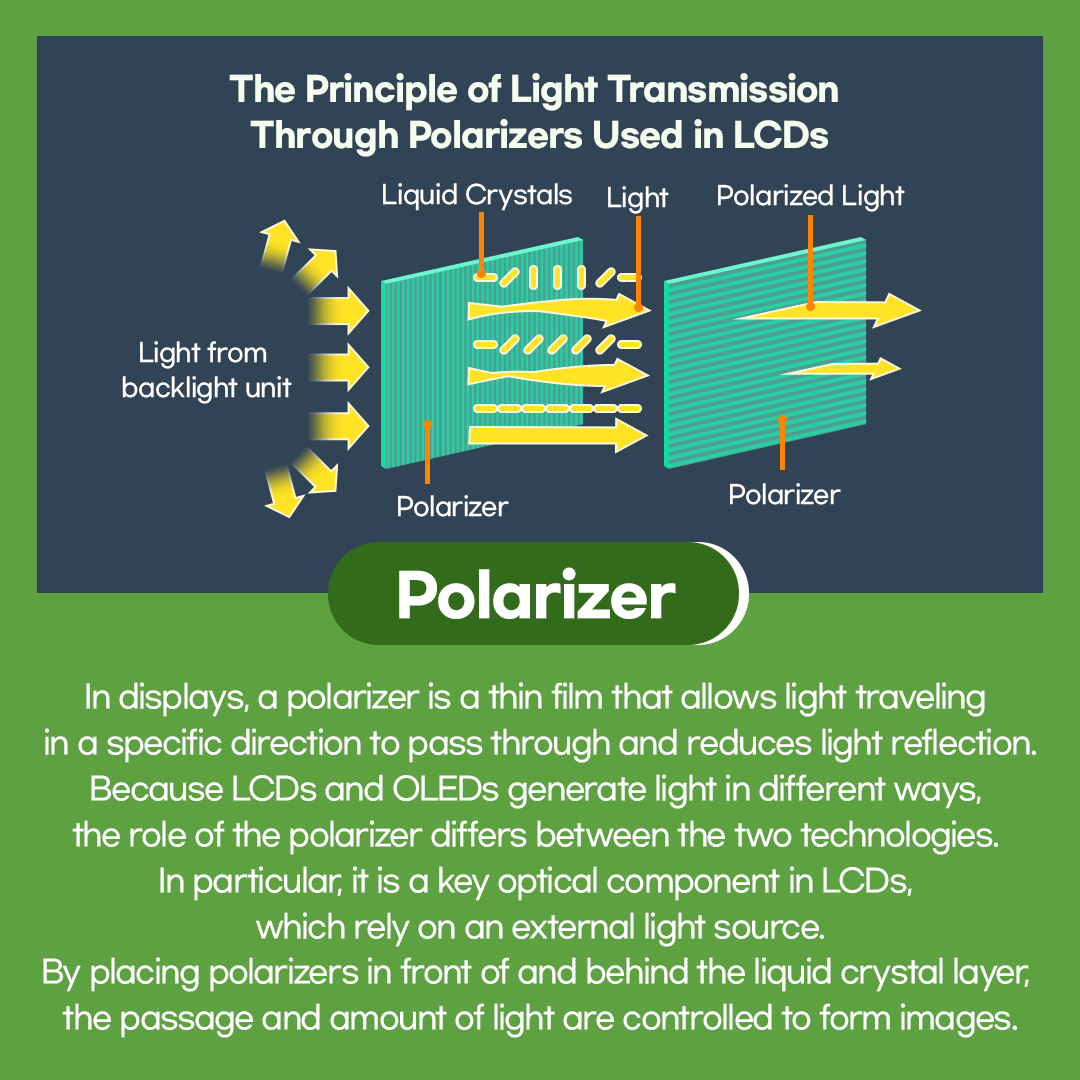
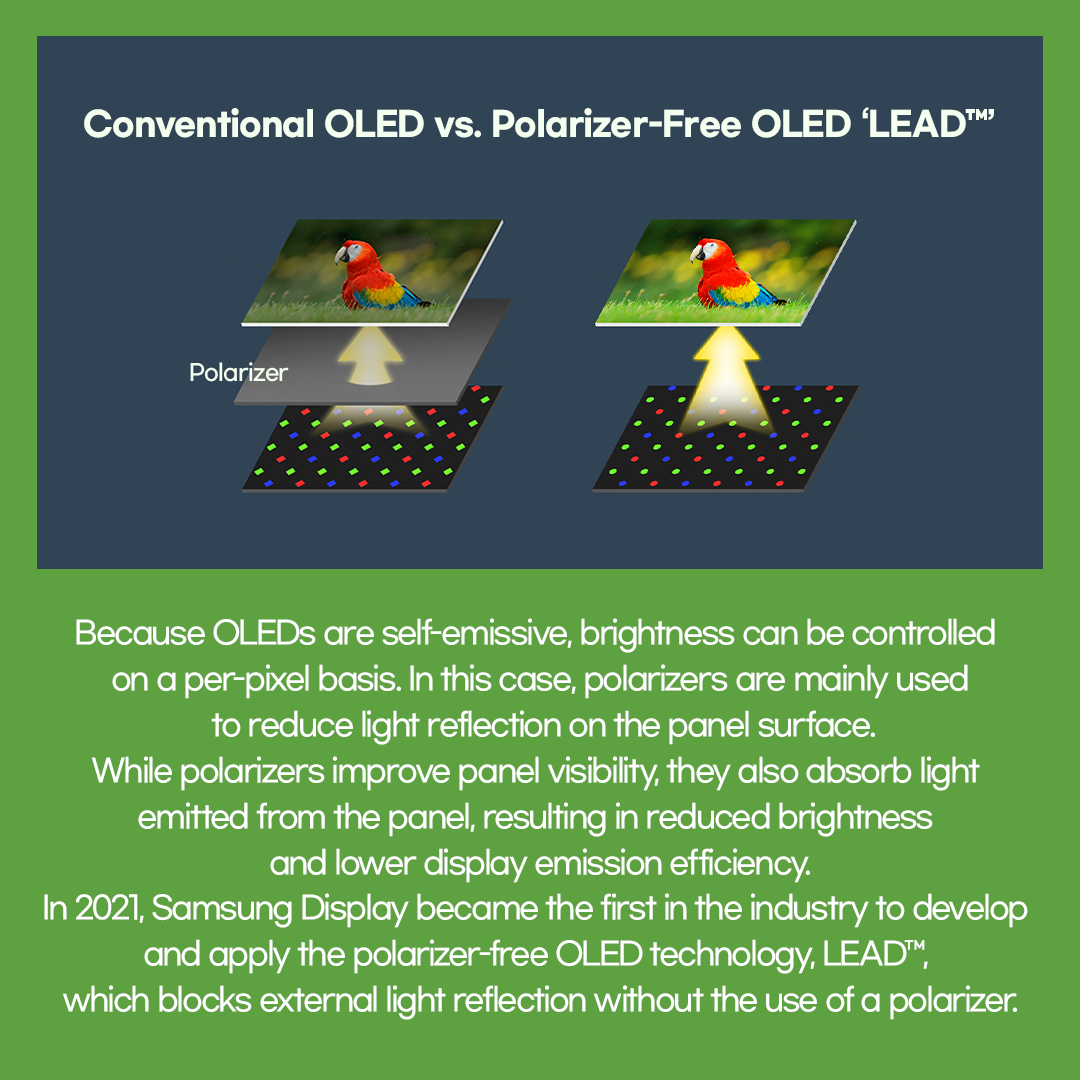

The Principle of Light Transmission Through Polarizers Used in LCDs Liquid crystals / Light / Light from backlight unit / Polarized Light  In displays, a polarizer is a thin film that allows light traveling in a specific direction to pass through and reduces light reflection. Because LCDs and OLEDs generate light in different ways, the role of the polarizer differs between the two technologies. In particular, it is a key optical component in LCDs, which rely on an external light source. By placing polarizers in front of and behind the liquid crystal layer, the passage and amount of light are controlled to form images. Conventional OLED vs. Polarizer-Free OLED ‘LEAD™’ Because OLEDs are self-emissive, brightness can be controlled on a per-pixel basis. In this case, polarizers are mainly used to reduce light reflection on the panel surface. While polarizers improve panel visibility, they also absorb light emitted from the panel, resulting in reduced brightness and lower display emission efficiency. In 2021, Samsung Display became the first in the industry to develop and apply the polarizer-free OLED technology, LEAD™, which blocks external light reflection without the use of a polarizer.