
• “Clear from the front, darkened from all other angles”… UL Solutions verifies Samsung Display’s privacy performance
• In the AI era, where data usage continues to surge, Flex Magic Pixel™ (FMP) technology helps prevent leakage of personal information when using smartphones in public or crowded spaces
• Combines Samsung Display’s patented OLED multi-layer light-blocking structure with high-brightness, low-power LEAD™ technology, delivering a differentiated, panel-integrated privacy solution under LEAD 2.0™
• Samsung Display to operate an exhibition zone at MWC26 where visitors can experience the FMP technology firsthand
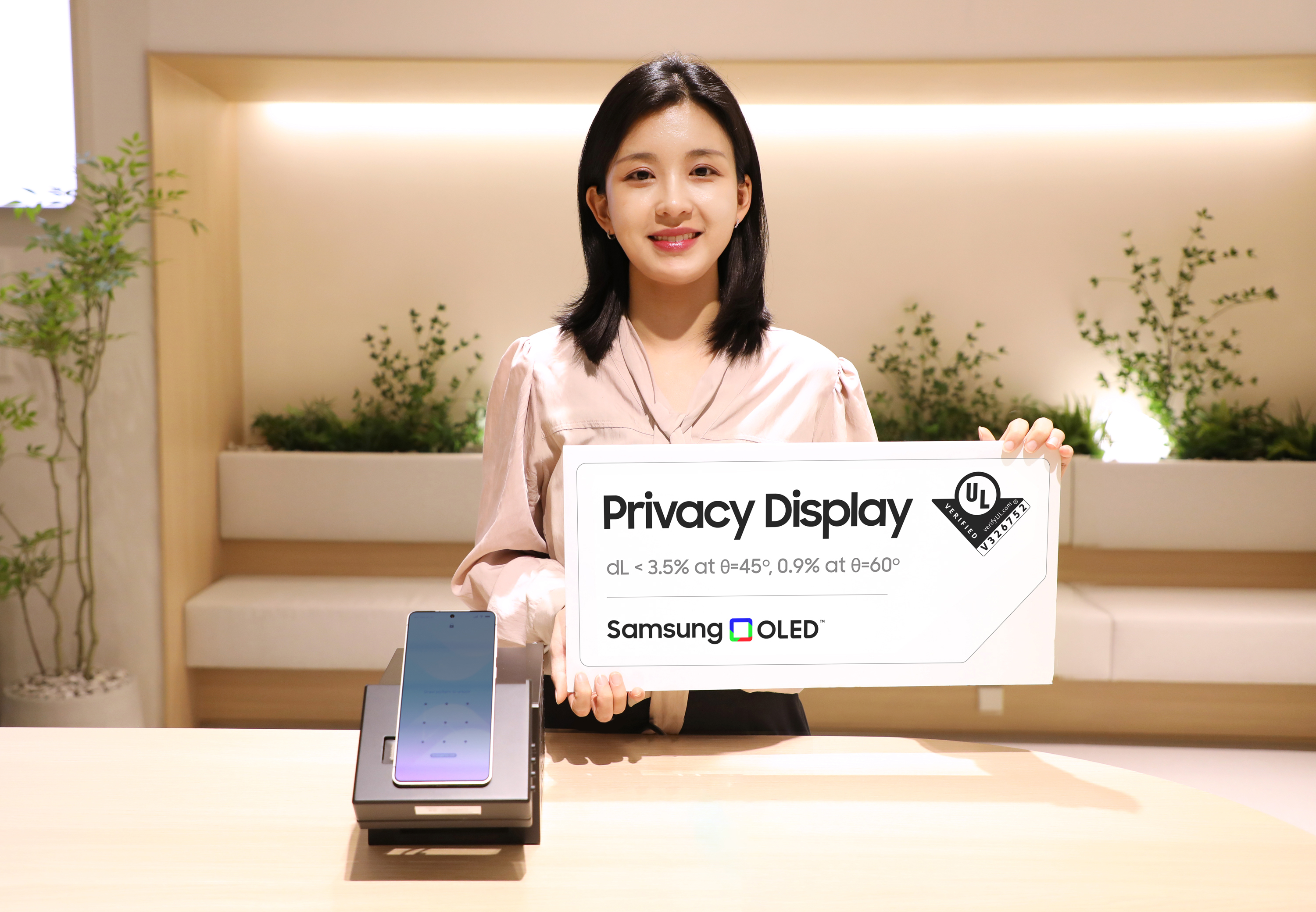
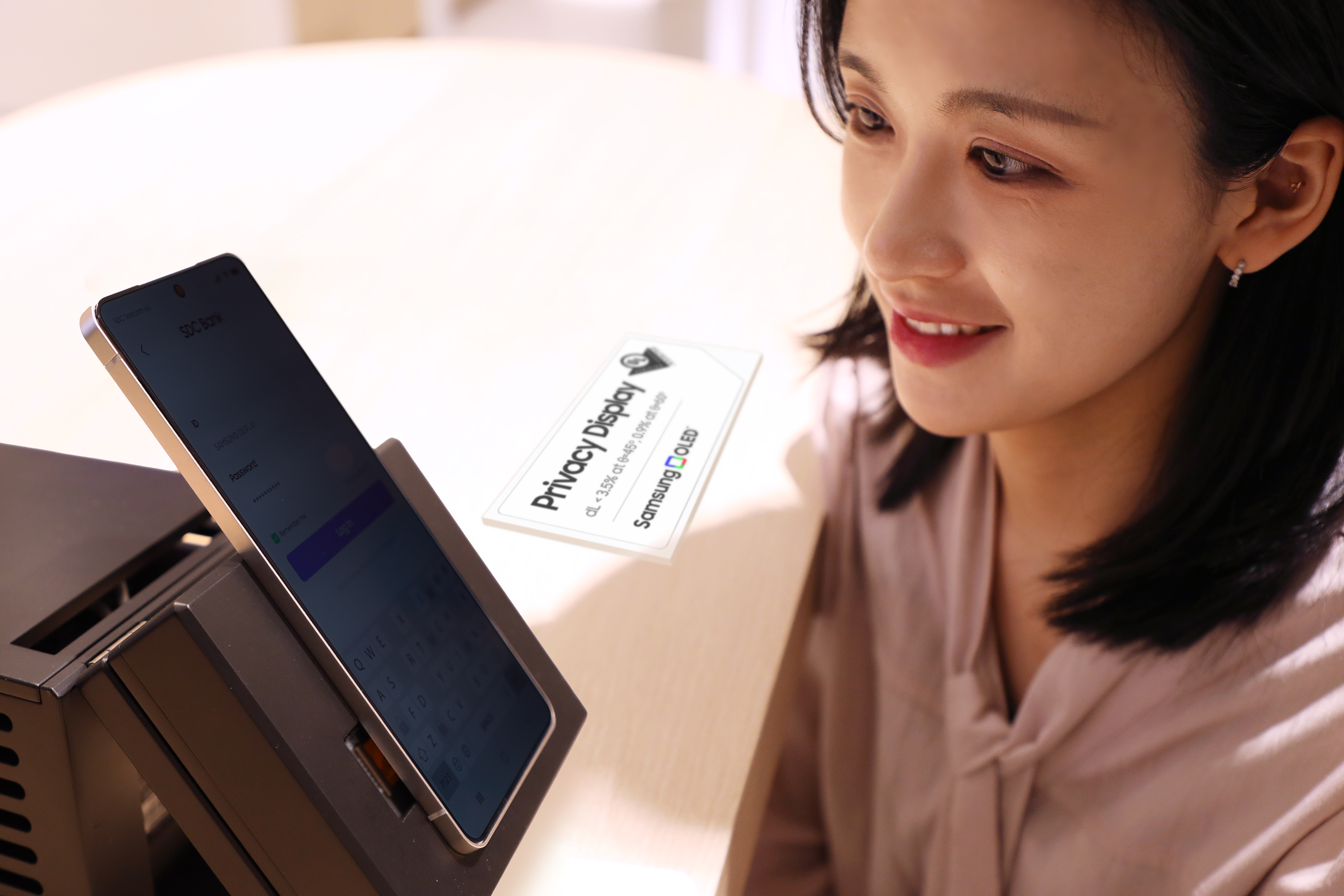
SEOUL, February 26, 2026 - Samsung Display’s smartphone OLED featuring its next-generation privacy technology, Flex Magic Pixel™ (FMP), has received UL Solutions’ “Privacy Display” verification. Flex Magic Pixel™ is a panel-integrated privacy technology that allows content to remain clear when viewed from the front while appearing blurred or nearly invisible from side angles, helping protect users’ personal information.
Global safety science company UL Solutions evaluated Samsung Display’s smartphone OLED equipped with FMP technology and verified that it delivers viewing-angle privacy performance in all off-axis directions – up, down, left and right. A UL Solutions official stated, “To test the performance, the OLED panel was tilted at 45 and 60 degrees and rotated 360 degrees to measure the brightness reduction at off-angles compared to front viewing. Samsung Display’s OLED panel equipped with FMP technology recorded a side-to-front brightness ratio of 3.5% at 45 degrees and 0.9% or lower at 60 degrees.” Assuming frontal brightness as 100, brightness at a 45-degree side angle is reduced to 3.5, equivalent to approximately one-thirtieth of the frontal level. At a 60-degree angle, it drops below 0.9, corresponding to less than one-hundredth of the frontal brightness.
Conventional smartphone panels typically maintain around 40% of their front-facing brightness when viewed from an angle, making on-screen content visible to others.
Samsung Display first unveiled the Flex Magic Pixel™ technology at MWC24 in 2024. As data usage continues to increase in the AI era, concerns over personal information leakage and privacy exposure through smartphones in public spaces have grown, driving growing interest in such technology among global set manufacturers.
“In the past, many users purchased and attached separate protective films to their smartphones due to concerns about privacy exposure. However, such films often reduce screen brightness even in situations where privacy protection is not needed. Flex Magic Pixel™ allows users to turn the privacy function on or off by controlling the viewing angle at the pixel level. When the privacy mode is turned off, users can enjoy excellent image quality without any reduction in screen brightness, even when viewed from the front,” said a Samsung Display representative.
Since 2020, Samsung Display has filed approximately 150 patent applications related to key technologies required to implement Flex Magic Pixel™, strengthening its technological competitiveness. At the core of FMP technology are panel design technology and precision deposition processes that precisely control subpixels, each only a few micrometers in size and the basic units that form a display, to control the spread of light.
To regulate the degree of light diffusion emitted from certain subpixels, Samsung Display modified the design structure of the Black Matrix (BM)[1], a key OLED structure that separates RGB subpixels and prevents color mixing between them. While the Black Matrix is typically formed as a single layer, Samsung Display developed a multi-layer, light-blocking structure in which multiple BM layers are precisely arranged, and combined it with LEAD™[2], its polarizer-free OLED technology known for high brightness and low power consumption, to complete the FMP technology. This enhanced evolution of LEAD™ is introduced by the company as “LEAD 2.0™[3].”
“LEAD 2.0™ is an innovative technology that maximizes security and privacy through all-around viewing angle control while simultaneously improving power efficiency, the most critical challenge in the era of on-device AI,” said Hojung Lee, Executive Vice President and Head of Mobile Display Product Planning Team at Samsung Display. “We will continue to focus on developing new technologies to enhance the convenience of smartphone users.”
Samsung Display will unveil a smartphone demonstration product equipped with LEAD 2.0™ at MWC26, opening on March 2 (local time) in Barcelona, Spain. At the exhibition, visitors will be able to experience not only full-screen privacy protection but also a “Partial Privacy” feature that can be applied only to specific areas of the display.
[1] Black Matrix: Black demarcation between the red, green, and blue (RGB) subpixels in a display. Commonly abbreviated as BM, it serves as a partition that defines each subpixel area while preventing colors mixing between subpixels.
[2] LEAD™: A polarizer-free OCF (On-Cell Film) technology first developed by Samsung Display in 2021. By eliminating the polarizer previously required in conventional OLED panels and integrating anti-reflection functionality directly into the panel, LEAD™ enhances brightness while reducing power consumption.
[3] LEAD 2.0™: A premium OLED technology that combines LEAD™ with the privacy protection technology Flex Magic Pixel™ (FMP), delivering high brightness, low power consumption, and advanced privacy protection.
