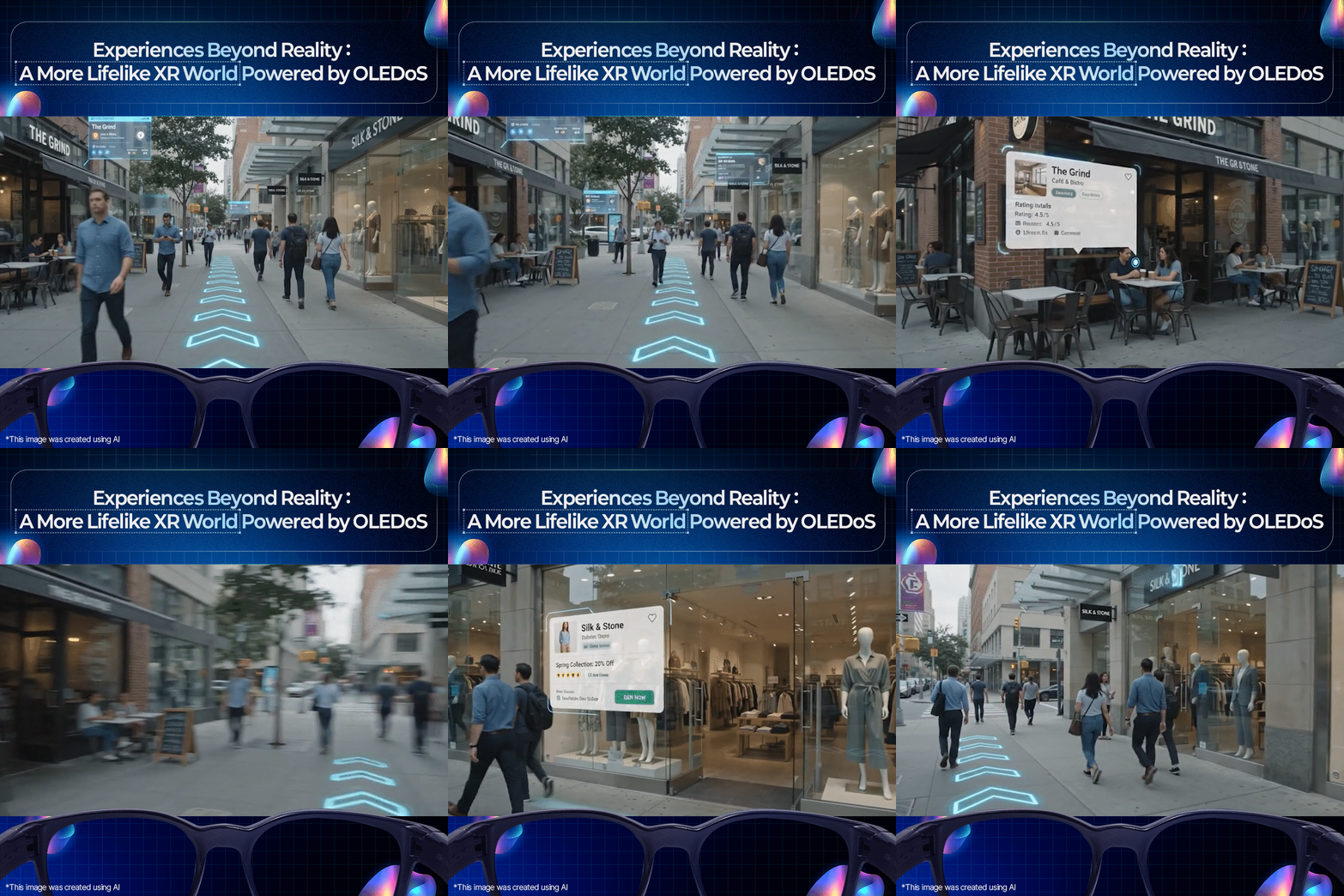
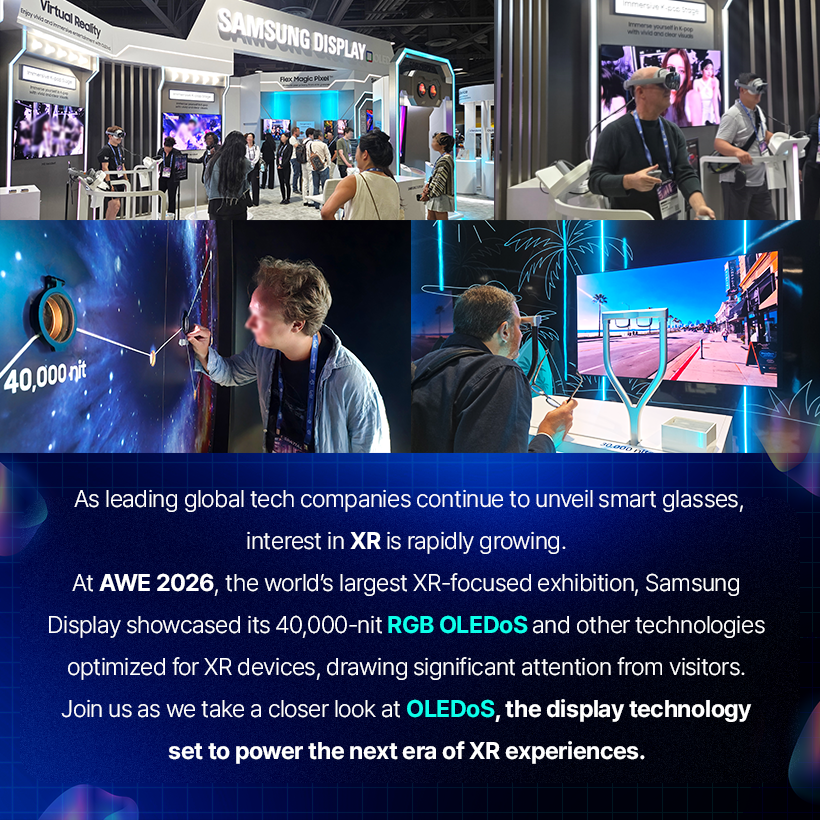
As leading global tech companies continue to unveil smart glasses, interest in XR is rapidly growing. At AWE 2026, the world's largest XR-focused exhibition, Samsung Display showcased its 40,000-nit RGB OLEDoS and other technologies optimized for XR devices, drawing significant attention from visitors. Join us as we take a closer look at OLEDoS, the display technology set to power the next era of XR experiences.
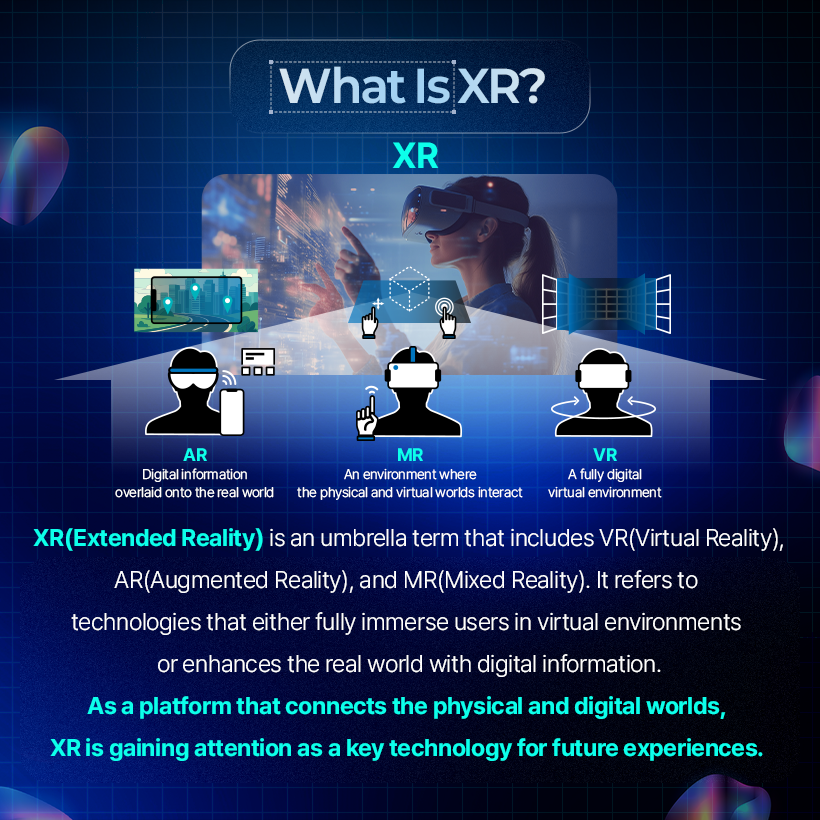
XR(Extended Reality) is an umbrella term that includes VR(Virtual Reality), AR(Augmented Reality), and MR(Mixed Reality). It refers to technologies that either fully immerse users in virtual environments or enhances the real world with digital information. As a platform that connects the physical and digital worlds, XR is gaining attention as a key technology for future experiences.
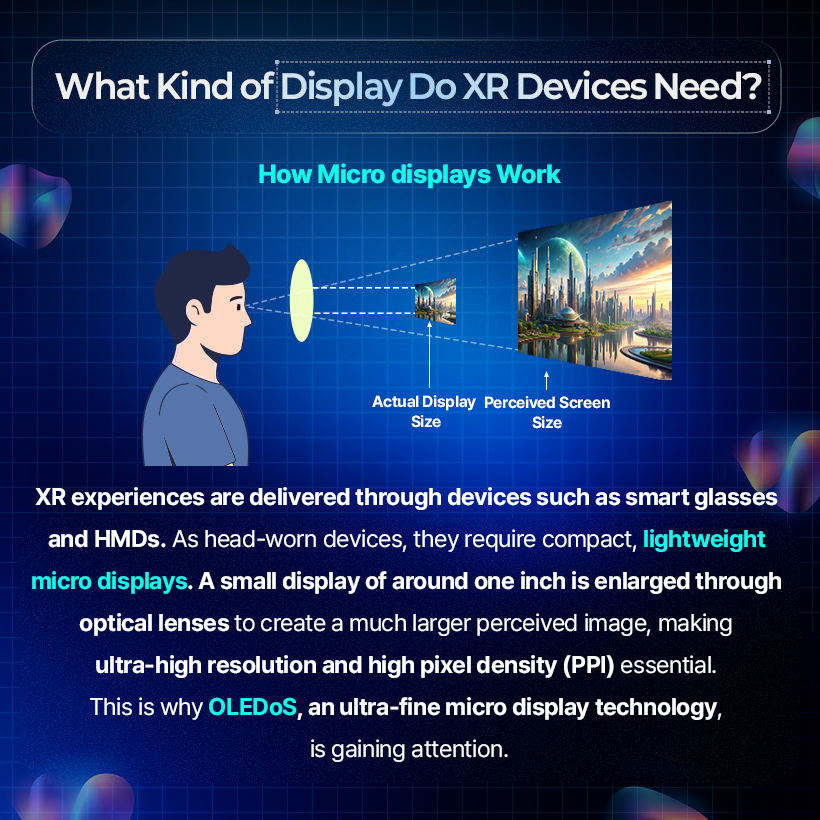
and HMDs. As head-worn devices, they require compact, lightweight micro displays. A small display of around one inch is enlarged through optical lenses to create a much larger perceived image, making ultra-high resolution and high pixel density (PPI) essential. This is why OLEDoS, an ultra-fine micro display technology, is gaining attention.  XR experiences are delivered through devices such as smart glasses
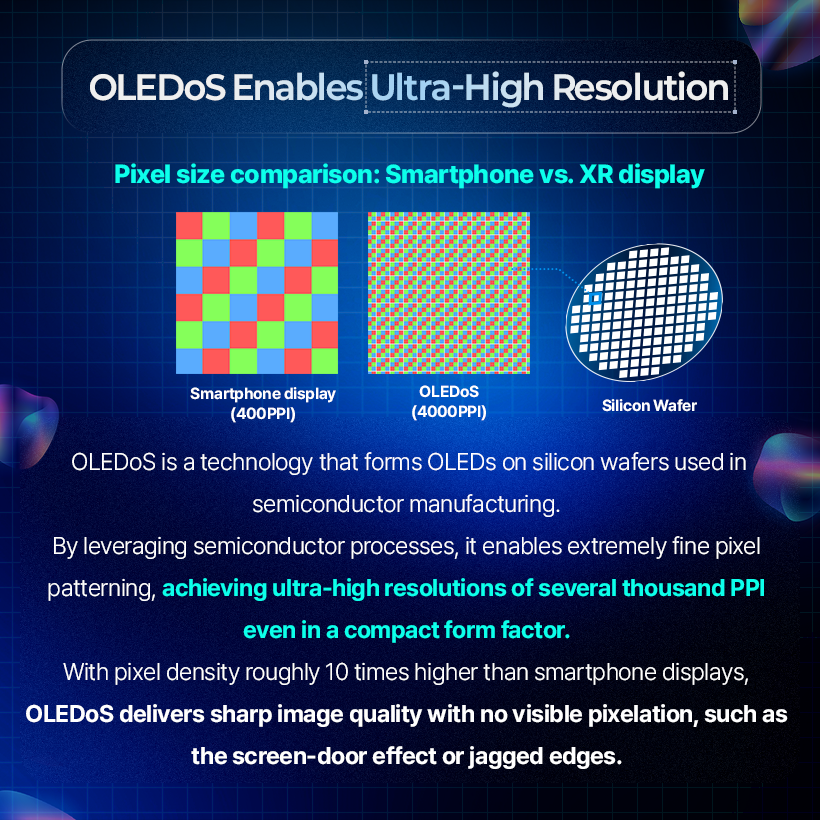
OLEDoS Enables Ultra-High Resolution  Pixel size comparison: Smartphone vs. XR display  Smartphone display  OLEDOS  (400PPI)  (4000PPI)  Silicon Wafer  OLEDoS is a technology that forms OLEDs on silicon wafers used in semiconductor manufacturing. By leveraging semiconductor processes, it enables extremely fine pixel patterning, achieving ultra-high resolutions of several thousand PPI even in a compact form factor. With pixel density roughly 10 times higher than smartphone displays, OLEDoS delivers sharp image quality with no visible pixelation, such as the screen-door effect or jagged edges.
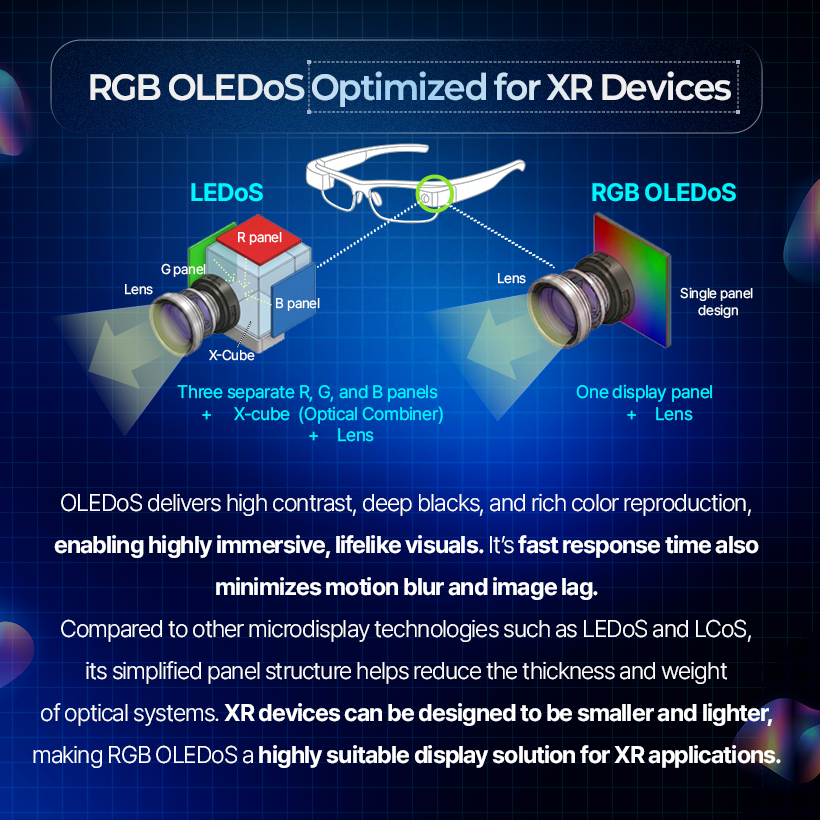
RGB OLEDoS Optimized for XR Devices  LEDOS  RGB OLEDOS  R panel  G panel Lens  Lens  B panel  Single panel design  X-Cube Three separate R, G, and B panels  One display panel  +  X-cube (Optical Combiner)  + Lens  + Lens  OLEDoS delivers high contrast, deep blacks, and rich color reproduction, enabling highly immersive, lifelike visuals. It's fast response time also minimizes motion blur and image lag. Compared to other microdisplay technologies such as LEDoS and LCoS, its simplified panel structure helps reduce the thickness and weight of optical systems. XR devices can be designed to be smaller and lighter, making RGB OLEDoS a highly suitable display solution for XR applications.